The "Industry and Management Forum" focuses on corporate management practices and industrial development issues. This journal encourages papers that combine theory and practice. To enable practitioners to quickly absorb management theories and new knowledge, authors are encouraged to simplify complex research processes and use plain language, practical cases, and simple charts to explain theories, definitions, and concepts. The journal also regularly publishes case discussions, encouraging scholars to develop indigenous Chinese cases for teaching purposes to share and pass on the growth and management experiences of industry players.
Call for Papers
Submitted articles are categorized into three types: Research Papers, Case Discussions, and Perspective Papers.
- Research Papers: Generally around 15,000 words; research results should contribute to management practice or industrial development.
- Case Discussions: Generally around 15,000 words; submissions should be presented as teaching cases and must provide both the "Case Body" and "Teaching Note". Priority is given to Library Cases based on public data, and the data sources must be publicly accessible. For Field Cases involving real companies and internal data, contributors must obtain a Case Authorization Letter from the company to confirm that relevant copyright authorization has been granted.
- Perspective Papers: Generally around 6,000 words; must be based on relevant literature and research methods, providing insights into new knowledge and new research directions for the future of the management field.
The core value of perspective articles in this journal lies in "forward-looking insights grounded in existing research and emerging practical phenomena," with arguments focused on inspiring significant future scholarly contributions. With this value in mind, the journal seeks perspective articles that demonstrate strength in three areas:
- Distinctiveness of argument and impact on the field. Submissions must offer unique and thought-provoking insights built upon existing evidence, challenge prevailing assumptions or frameworks, and point toward productive research directions for the next 5 to 10 years.
- Rigor and objectivity of reasoning. Arguments must be well-supported by the literature and grounded in sound logical reasoning. Submissions should present opposing viewpoints objectively and clearly distinguish between evidence-based claims and the authors' forward-looking inferences.
- Concrete directions for future research and practice. Articles should go beyond identifying problems or phenomena to offer actionable directions for subsequent scholarly inquiry in the field, as well as specific practical implications for managers or policymakers.
The corresponding author of the manuscript should also fill out the "Contributor Basic Information Form" and upload both files to the submission website. The journal decides whether to publish based on its review system. Unless stated otherwise in advance, the journal reserves the right to modify text and formatting. Regardless of acceptance, manuscripts will not be returned; please keep your own copies.
Manuscripts should not be submitted to multiple journals simultaneously. Upon acceptance, authors will receive two complimentary copies of the current issue. Print issues are published quarterly in March, June, September, and December.
Upon acceptance, authors agree to authorize this journal to sub-license the National Central Library's "Remote Electronic Access Service System" or other database providers for reproduction, network-based service provision, and user downloading, printing, and browsing. Format modifications may be made to meet the requirements of the "Remote Electronic Access Service System" or other databases.
Membership Application
This journal publishes four issues per year. A journal subscription (NT$2,000 per year) grants one year of membership. Subscription fees must be paid in advance; members may receive occasional free special issues and a 10% discount on conference registration fees. Subscribers please use:
- 【Postal Transfer】 Account Number: 19614730; Account Name: Industrial Technology Research Institute.
- 【Bank Transfer】 Bank: Land Bank of Taiwan, ITRI Branch; Account Number: 156005000025; Account Name: Industrial Technology Research Institute.
Content
This journal serves as a platform bridging academic research and professional practice in the field of general management, and welcomes research contributions that advance management practice or industrial development. Manuscripts should be written in Chinese or English, formatted horizontally (left to right), and submitted as a Microsoft Word file.
Title and Abstract
The title should be concise and clearly convey the key concepts and contributions of the manuscript. Submissions must include, before the main text, both a Chinese and an English title, abstracts in both languages (each not exceeding 500 words), and keywords in both languages (3 to 5 keywords each).
Manuscript Specifications
Chinese font: BiauKai; English font: Times New Roman.
Font size: 12
Line spacing: 1.5
- Heading Styles
All headings should be left-aligned. The hierarchy should follow:
壹、 Introduction (Roman numerals)
一、 Structural Patterns of High-Tech Industries
(一) Case Analysis of Structural Patterns in the Electronics Industry
For smaller levels, use the order: 1., (1), a, (a), etc.
- Citations
Instructions and examples for citing others' literature are as follows:
- Some studies support this argument (Hung, 2002; Alvarez, 2003; Morrill & Zald, 2000).
- Weick’s (2007) study supports this argument.
- When there are five or fewer authors, list all names in the first citation, e.g., (Kim, Oh, & Swaminathan, 2006); subsequent citations use (Kim et al., 2006). If there are six or more authors, use "et al." directly from the first citation.
- For cases not listed above, please handle by analogy.
- Handling Tables and Figures
- Important tables and figures should be placed in appropriate locations within the text.
- Tables and figures that are too detailed or numerous should be placed in an appendix.
- If tables or figures are cited from others, the source must be indicated.
References
APA (American Psychological Association) 7th Edition Reference Examples
List the reference list and in-text citations. Chinese references (with English translations added) should be placed before English references. Chinese references should be arranged by the stroke count of the author's surname, and English references by the alphabetical order of the author's surname (if surnames and letters are identical, compare subsequent characters in order).
In response to the new TSSCI journal evaluation system released by the Research Center for Humanities and Social Sciences on 2025.12.29, all Chinese references in articles must be accompanied by Romanized pinyin or English translations (as in the following example).
Huang, C. L. (2022). Sustainable Development of Innovative Community Care and University Social Responsibility in the Post-Pandemic Era. The Journal of Nursing, 69(3), 4-6.
1.Journals
Author (Year). Title. Journal Name, Volume(Issue), page numbers. DOI (if any).
Example:
Lin, C. (2018). Inquiry-based Information Literacy Integration into Curriculum in Elementary Schools: Theory and Practice. Journal of Educational Media & Library Sciences, 55(2), 103-137.
Huang, C. L. (2022). Innovative Community Care and the Sustainable Development of University Social Responsibility in the Post-Pandemic Era. The Journal of Nursing, 69(3), 4-6. https://doi.org/10.6224/JN.202206_69(3).01
Cole, T. W., Han, M.-J., Weathers, W. F., & Joyner, E. (2013). Library marc records into linked open data: Challenges and opportunities. Journal of Library Metadata, 13(2-3), 163-196.
https://doi.org/10.1080/19386389.2013.826074
Baig. (2021). Chronic COVID syndrome: Need for an appropriate medical terminology for long‐COVID and COVID long‐haulers. Journal of Medical Virology, 93(5), 2555–2556.
https://doi.org/10.1002/jmv.2662
*Journal name and volume number must be in italics.
2.Chinese Magazines and Newspaper Articles
- Print Magazine Articles
Author (Year, Month). Article Title. Magazine Name, Volume(Issue), page numbers.
Chiu, C. Y. (2019, March). Open Access Policy Cooperation and Sharing between University Presses and University Libraries. Taiwan Publishing and Reading, 5, 4-7.
Milliot, J. (2020, February 17). Publishers, printers meet to talk shop. Publishers Weekly, 267(7), 10.
- Online Magazine Articles
Author (Year, Month, Day). Article Title. Magazine Name. URL.
- Newspaper Articles (Print and Online)
Author (Year, Month, Day). Article Title. Newspaper Name. Section or URL.
Example:
Ho, T. C. (2019, April 9). Sales Tax Exemption for Publishing Case, Ministry of Culture: Positive Development. United Daily News, Section A6.
Wu, P. H. (2020, February 17). Epidemic Outbreak Drives Popularity of E-book Readers; Must-knows for Buyers. Liberty Times. https://ent.ltn.com.tw/news/breakingnews/3071117
3. Books (Single Book, Book Chapter, Translated Book)
- Single Author
Author (Year). Book Title (Edition). Publisher. DOI or URL (if any).
- Two or More Authors
Author 1, & Author 2 (Year). Book Title (Edition). Publisher. DOI or URL (if any).
Example:
Lin, R. H. (2014). Romanization of Academic Journals: APA, Chicago (Turabian) and Romanized Citation Format Specifications. Tamkang University Press.
- Edited Books
Editor (Ed.). (Year). Book Title. Publisher.
Wang, D. M. (Ed.). (2023). Educational Policy and Reform. Wunan Book Co., Ltd.
- Books Translated into Chinese
Author (Year). Book Title [Translator, Trans., Edition]. Publisher. (Original work published Year)
Luey, B. (2013). Handbook for Academic Authors: From Journal Articles and Monographs to Textbooks and General Books (C. Y. Chen, Trans.). Socio Publishing. (Original work published 2009)
Šteger, A. (2010). The Book of Things (B. Henry, Trans.). BOA Editions. (Original work published 2005)
- Dictionaries, Thesauruses, and Encyclopedias
Author or Group Name (Year). Book Title. Date, retrieved from URL (if any)
Author or Group Name (Year). Book Title (Edition). Publisher. URL (if any)
Example:
Ministry of Education (2023). Concise Mandarin Dictionary (3rd ed.). Taiwan Commercial Press.
Ministry of Education (2023). Revised Mandarin Dictionary. Retrieved from https://dict.revised.moe.edu.tw/
4. Book Chapters
- A Chapter in an Edited Book
Author (Year). Chapter Title. In Editor (Ed.), Book Title (Edition, pp. XX-XX). Publisher. DOI (if any)
Wang, X. M. (2023). New Trends in Qualitative Research Methods. In L. Hua (Ed.), Handbook of Educational Research (2nd ed., pp. 45-68). Wunan Book Co., Ltd. https://doi.org/10.xxxx/xxxxx
- Translated Chapter in an Edited Book
Author (Year). Chapter Title. [Translator, Trans.]. In Editor (Ed.), Book Title (pp. XX-XX). Publisher. (Original work published Year)
5. Conference Reports
- Paper Presented at a Conference
Presenter (Year, Month Day / Conference Duration). Title of Work [Paper presentation]. Conference Name, Conference Location (City and Country). URL (if any)
- Poster/Wall Chart Presented at a Conference
Presenter (Year, Month Day / Conference Duration). Title of Work [Poster presentation]. Conference Name, Conference Location (City and Country). URL (if any)
6. Theses and Dissertations
- Unpublished Thesis/Dissertation
Author (Year). Title of Thesis/Dissertation [Unpublished Master's/Doctoral thesis]. Name of University or Degree-granting Institution.
- Thesis/Dissertation in a Database
Author (Year). Title of Thesis/Dissertation (System ID: XXXX) [Master's/Doctoral thesis, Name of University or Degree-granting Institution]. Database Name.
- Thesis/Dissertation Published Online (Not in a Database)
Author (Year). Title of Thesis/Dissertation [Master's/Doctoral thesis, Name of University or Degree-granting Institution]. Website Name. URL
Further Reading
To help readers explore the topics discussed in the article more deeply, authors are asked to provide a list of recommended books or articles following the reference list. Please include 1 to 5 further readings that do not overlap with the references cited in the manuscript and follow the same formatting style as the reference list.
Online Submission and Review System
Authors please submit to the journal website at https://www.ipress.tw/J0210. To check manuscript progress, please log in to the iPress system.
For any questions, please email the journal at if@itri.org.tw; we will respond as soon as possible.
Review System and Handling Procedures
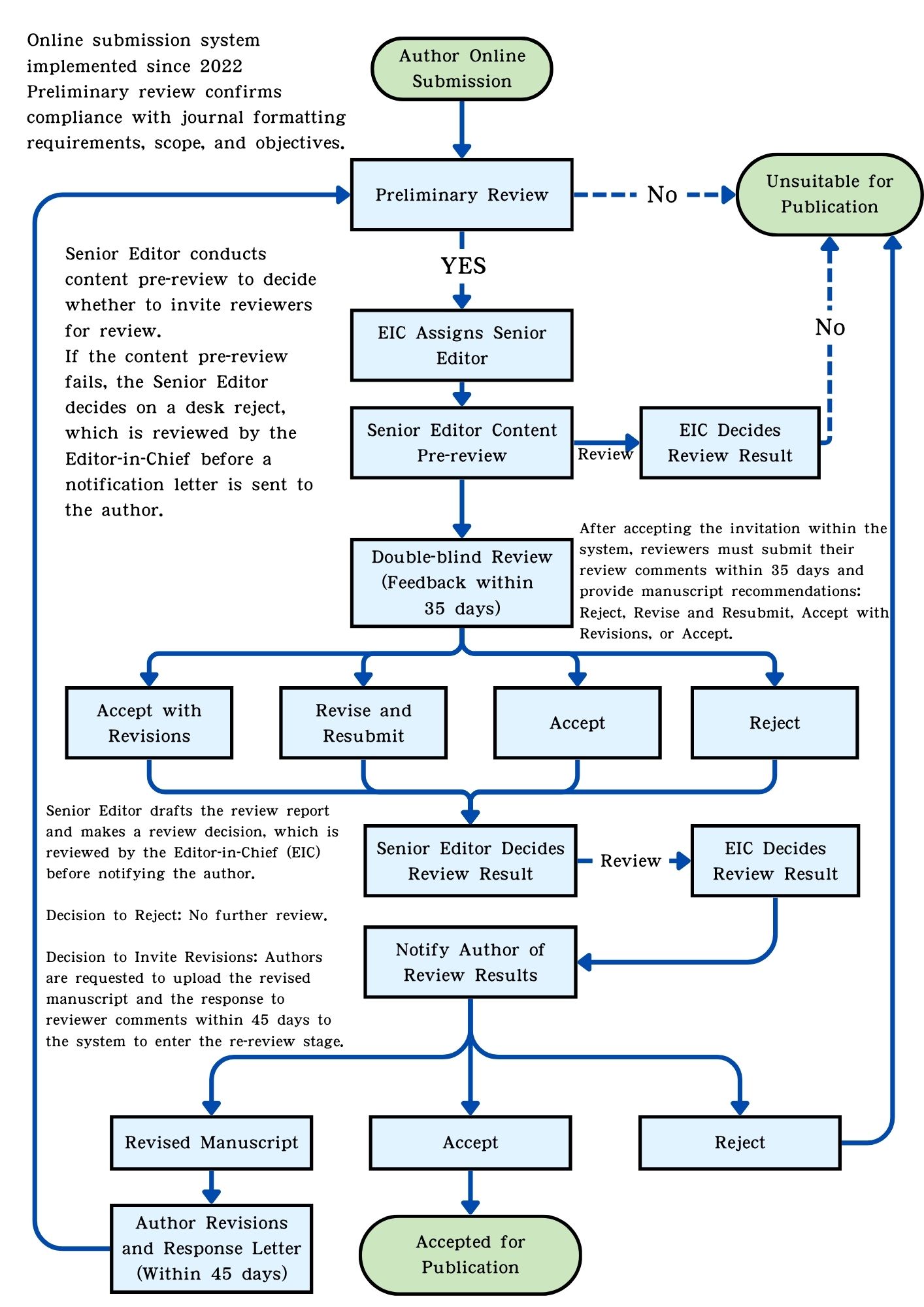
- Submitted papers first undergo a preliminary review by the Editor-in-Chief. If the paper is found not to conform to the journal's mission or has serious research flaws or errors, it will be rejected immediately.
- Manuscripts that pass the preliminary review are transferred to the Subject Editor. The Subject Editor may reject the paper, provide preliminary revision suggestions for re-review, or assign it to two (or more) anonymous reviewers for review. Finally, the Subject Editor decides whether to reject, request revisions, or accept the manuscript.
- The journal will endeavor to respond to authors with the review results within eight weeks of receipt and provide constructive and developmental suggestions for revision.
This journal welcomes authors to use generative AI as an auxiliary tool, such as for text polishing, data organization, or chart creation. However, the process must adhere to the principle of "Responsible Use of Generative AI". Upon submission, a "Generative AI Usage Description" must be included at the end of the text to clearly disclose the method and scope of AI usage.
Based on the stance of adhering to research ethics, if irresponsible AI usage is discovered, the journal will handle it rigorously and take appropriate measures. Irresponsible AI usage defined by this journal includes:
- Massive direct use of generative AI content as the main text or research analysis of the paper
- Using generative AI to generate fictitious literature, data, or fabricated research results
- Concealing the usage of generative AI
Generative AI Usage Statement (Example)
During the writing of this study, the author used [Name of Generative AI Tool] to assist with [Purpose/Scope of Use, e.g., text polishing, sentence restructuring, data organization, drafting of chart descriptions]. Relevant content was re-examined, verified, and adjusted by the author according to actual needs. The author assumes full responsibility for the accuracy, originality, and final published outcome of the research content.
The Industry and Management Forum is committed to publishing high-quality papers that focus on Taiwan's industry and management issues. To ensure that every stage of the publication process complies with international standards of publication ethics, this journal has established this ethics statement in accordance with the Committee on Publication Ethics (COPE). This statement applies to all parties involved in the journal's publication process, including authors, reviewers, and editors. Upholding academic integrity as a core value, this journal does not accept manuscripts involving academic misconduct, including plagiarism, duplicate submission, data fabrication or falsification, improper authorship, or undisclosed conflicts of interest. Through clear ethical standards, this journal seeks to work with all participants to maintain a sound academic research environment.
Duties of Editors
- Publication Decisions and Fair Review
Editors of this journal have independent authority and responsibility for accepting or rejecting manuscripts. Editors may consider reviewers' comments during the review process, but the final decision rests with the editor. Editorial decisions must maintain academic independence and be based on the manuscript's originality and contribution to knowledge in the field. Manuscripts must not be treated differently because of personal positions or preferences. During the review process, the identities of authors and reviewers shall be kept confidential to maintain a fair and objective review procedure. If a review lacks substantive academic judgment, the editor may request another review or decline to adopt the review.
- Confidentiality and Conflict of Interest Avoidance
Editors and editorial office staff are obligated to keep all information related to submitted manuscripts and the review process confidential. Unpublished manuscript content must not be disclosed to any third party or used for personal research purposes. If an editor has a competitive relationship, collaborative relationship, or any other connection with the submitting author that may affect judgment, the editor should recuse themselves from handling the manuscript and transfer it to another editor.
- Handling Academic Misconduct
If there are indications that a submitted manuscript or published article involves academic misconduct, such as data fabrication, plagiarism, duplicate publication, or misuse of AI tools, editors are responsible for initiating an investigation and, as appropriate, issuing corrections or retraction statements and taking other necessary measures.
Duties of Reviewers
- Objective and Professional Review
Reviewers' comments should be specific, objective, and constructive. Personal criticism of authors or comments lacking academic basis are not acceptable. Reviewers must keep received manuscripts strictly confidential, must not disclose manuscript content to any third party, and must not cite the ideas or data contained in the manuscript before it is formally published.
- Conflict of Interest Avoidance and Review Timeliness
If reviewers have a competitive or collaborative relationship with the manuscript's authors, funding organizations, or research topic, they should proactively inform the editor and request recusal. Reviewers should complete their reviews within the agreed timeframe. If they are unable to do so, they should notify the editor as soon as possible so that other arrangements can be made.
Duties of Authors
- Originality and Plagiarism
Submitted manuscripts must be the authors' original work. When authors cite the words or research results of others, appropriate citation and attribution must be provided. Direct copying, close paraphrasing, or the use of others' concepts without proper citation or attribution shall be regarded as academic misconduct. This journal also does not accept self-plagiarism, including reusing text from authors' own previously published articles without explanation or splitting essentially the same research into multiple papers for submission to different journals.
- Authorship
All listed authors must have made substantial contributions to the conception, design, execution, data analysis, or interpretation of the research, and should review the final manuscript and agree to its publication. The corresponding author is responsible for confirming that all co-authors meet authorship qualifications and that no contributor who should be listed has been omitted. AI tools may not be listed as co-authors.
- Accuracy of Research Content
Authors are responsible for the accuracy of manuscript content, including the completeness of research data and the objectivity of presentation. Manuscripts must not deliberately omit data relevant to the research question. Research results must be presented truthfully, and the limitations and shortcomings of the research must be clearly explained. If important errors are discovered after publication, authors are obligated to notify the editorial office immediately and cooperate in making necessary corrections or retractions.